
How Inverter Heat Pumps Work (Variable-Speed Explained)
How Inverter Heat Pumps Work: A Guide for Nashville Homeowners
An inverter heat pump continuously adjusts its compressor speed to match
the amount of heating or cooling your home actually needs.
Instead of repeatedly turning on at full power and shutting off, an
inverter-driven system can operate at lower or higher output levels as
conditions change.
For Nashville homeowners, that variable operation can mean steadier indoor
temperatures, smoother airflow, quieter operation, and more consistent
humidity control during long periods of heating or cooling.
Understanding how inverter technology works can also help when comparing
equipment for a
heating system replacement
or new HVAC installation.
What Is an Inverter Heat Pump?
A conventional single-stage HVAC system generally has two operating
conditions: on and off. When the thermostat calls for heating or cooling,
the system starts at its designed output, runs until the thermostat is
satisfied, and then shuts down.
An inverter heat pump works differently. Its compressor can change speed
based on current demand. When the home needs only a small amount of heating
or cooling, the compressor can operate at a lower level. When demand
increases, it can increase its output.
The result is a system designed to match its capacity more closely to the
changing heating and cooling load inside the home.
How Does an Inverter Heat Pump Work?
At the center of the system is an inverter drive that
controls the speed of the compressor.
The compressor is responsible for circulating refrigerant through the heat
pump. Instead of operating at one fixed speed every time the system turns
on, an inverter-driven compressor can operate across a range of speeds.
In practical terms, this allows the heat pump to produce only the amount of
heating or cooling needed at a particular moment rather than repeatedly
operating at maximum output.
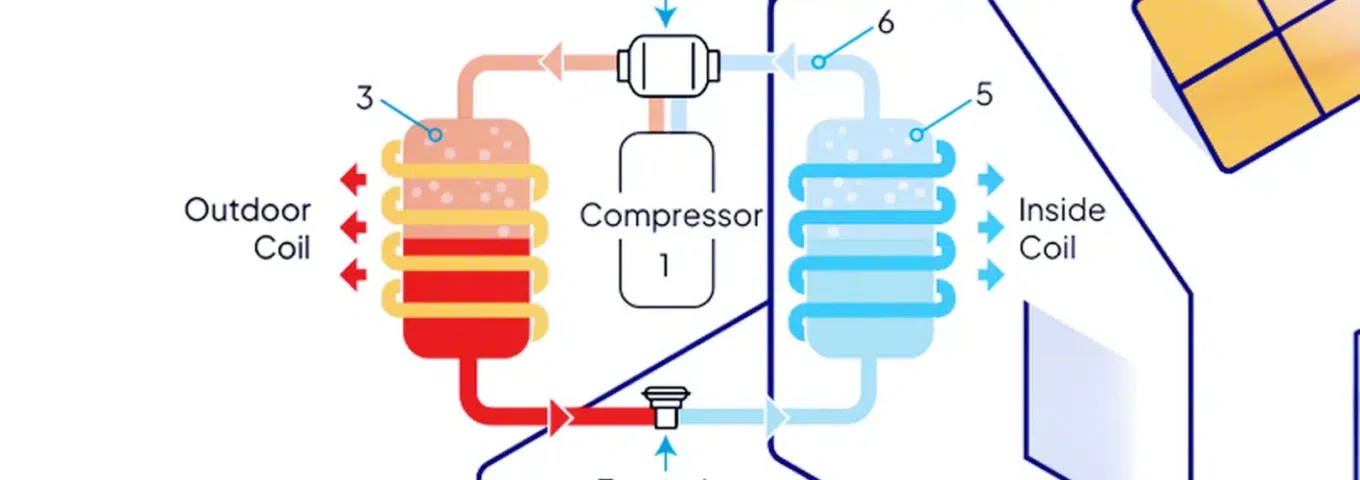
How a Heat Pump Transfers Heat
A heat pump does not heat a home in the same way a traditional furnace
does. Instead, it transfers heat using refrigerant, indoor and outdoor
coils, a compressor, and other system components.
Cooling Mode
During cooling operation, refrigerant absorbs heat from indoor air at the
indoor coil. The system then carries that heat outside, where it is
released through the outdoor coil.
Heating Mode
During heating operation, a reversing valve changes the refrigerant flow.
The outdoor portion of the system absorbs available heat energy from
outdoor air and transfers that heat indoors.
Even when outdoor temperatures are cold, heat energy is still present in
the air. The heat pump is designed to capture and move that energy into the
home.
What Does the Inverter Actually Change?
Inverter technology controls electrical frequency to regulate motor and
compressor speed.
For a homeowner, the important difference is that the HVAC system can
operate at many output levels rather than simply running at full capacity
every time there is a heating or cooling call.
-
Mild conditions: the compressor can operate at a lower
speed to maintain the thermostat setting. -
Higher demand: compressor speed can increase to provide
additional heating or cooling. -
Near the desired temperature: the system may continue
operating at a low output rather than shutting off completely.
This is why an inverter heat pump may appear to run for longer periods than
a traditional system. Longer runtime does not necessarily mean the system
is operating at full power the entire time.
Inverter Heat Pump vs. Traditional HVAC System
| Feature | Inverter Heat Pump | Traditional Single-Stage System |
|---|---|---|
| Compressor Output | Adjusts across multiple operating levels | Typically runs at a fixed output |
| Typical Operation | Longer, lower-output cycles | Full-output on/off cycles |
| Temperature Control | Designed for smaller temperature swings | May produce more noticeable cycling |
| Airflow | Can vary with system demand when paired with variable components | Often more noticeable when the system starts and stops |
| Sound | Often operates at lower sound levels during reduced-speed operation | Full-output starts may be more noticeable |
Why Inverter Heat Pumps Can Provide More Even Temperatures
Traditional single-stage systems are sometimes described as
all-or-nothing systems. They produce a noticeable cycle:
the equipment starts, delivers full output, reaches the thermostat setting,
and shuts off.
During the off period, indoor temperature gradually begins moving away from
the set point until another cycle begins.
An inverter heat pump can reduce the size of those temperature swings by
continuing to operate at a lower capacity when only a small amount of
heating or cooling is needed.
That steadier operation can be particularly noticeable in homes with:
- Longer duct runs
- Bonus rooms
- Rooms located over garages
- Areas with significant afternoon sun exposure
- Multiple floors with different heating or cooling demands
Inverter Heat Pumps and Nashville Humidity
Humidity plays a major role in summer comfort throughout Nashville and
Middle Tennessee. A home can reach the desired thermostat temperature and
still feel uncomfortable when indoor humidity remains high.
Air conditioning removes moisture when warm, humid indoor air passes across
the cold indoor coil and water vapor condenses.
Three important factors affect that process:
- Coil temperature
- Airflow
- System runtime
Because an inverter system can operate for longer periods at reduced
output, it may provide more continuous opportunities for moisture removal
than a system experiencing frequent short cycles.
However, equipment selection and airflow setup still matter. Homeowners
experiencing persistent moisture problems may also benefit from a dedicated
evaluation of their
indoor air quality and humidity-control options
.
Why Are Inverter Heat Pumps Often Quieter?
HVAC sound is affected by more than the maximum sound level of the
equipment. How often the system starts, stops, and changes airflow also
affects how noticeable it feels inside and outside the home.
Traditional equipment may create noticeable compressor starts and sudden
airflow changes because it begins operating at full output.
An inverter-driven system can spend significant amounts of time operating
below maximum capacity. At those lower operating speeds, compressor,
outdoor fan, and indoor airflow noise may be less noticeable.
This can be especially useful when an outdoor unit is located near a
bedroom, patio, deck, or another frequently used area.
Why Can Inverter Heat Pumps Use Less Energy?
One of the primary advantages of inverter technology is its ability to
match output more closely to the actual heating or cooling demand.
A home does not require maximum HVAC capacity every hour of every day.
During many mild or moderate conditions, only a fraction of the system’s
available capacity may be necessary.
Instead of repeatedly starting at full output and shutting down, an
inverter heat pump can operate at a lower level that more closely matches
that reduced demand.
This can reduce unnecessary cycling while maintaining more consistent
indoor conditions.
What Other Parts of an Inverter HVAC System Can Be Variable-Speed?
Many inverter heat pump systems are designed as matched HVAC systems rather
than simply pairing a variable compressor with conventional components.
Depending on the equipment, the system may also include:
-
Variable-speed outdoor fan:
Adjusts airflow across the outdoor coil based on operating conditions. -
Variable-speed indoor blower:
Changes indoor airflow based on heating, cooling, humidity, and system
demand. -
Electronic sensors:
Monitor system conditions and provide operating feedback. -
Communicating controls:
Allow compatible thermostats and equipment to exchange more detailed
operating information.
Why Proper Inverter Heat Pump Installation Matters
Advanced equipment cannot compensate for poor system design or improper
installation. An inverter heat pump still needs to be appropriately sized,
configured, and commissioned for the home.
Correct Equipment Sizing
Variable capacity does not eliminate the importance of equipment sizing.
An improperly selected system can still create comfort, humidity, or
performance problems.
Proper Airflow
The indoor coil needs the correct airflow to transfer heat and control
moisture effectively. Existing ductwork restrictions or airflow problems
can limit the performance of even sophisticated HVAC equipment.
Correct Refrigerant Setup
Heat pumps rely on controlled refrigerant conditions to absorb and release
heat. Proper installation and commissioning are therefore important to
system performance.
Compatible Controls
Some inverter systems use communicating thermostats or proprietary
controls that allow components to coordinate operating capacity and
airflow.
Right Time HVAC can evaluate your current system and help determine whether
an inverter or variable-capacity system makes sense when planning
AC replacement
or
heating system replacement
.
Are Inverter Heat Pumps Good for Nashville Homes?
Inverter heat pumps can be a practical option for Nashville homeowners who
value consistent temperature control, variable output, quieter operation,
and the ability to use one system for both heating and cooling.
Whether an inverter system is the right choice depends on more than the
technology itself. The home’s size, ductwork, insulation, existing HVAC
equipment, electrical requirements, comfort goals, and budget should all
be considered.
Right Time HVAC works with homeowners to compare equipment based on the
property rather than recommending a particular system simply because it is
newer technology.
Frequently Asked Questions About Inverter Heat Pumps
Does an inverter heat pump run all the time?
It may run for longer periods than a traditional single-stage system, but
it can operate at reduced capacity during much of that time. Longer,
lower-output operation is one of the ways an inverter system maintains
steadier indoor conditions.
Is it normal for an inverter heat pump to run at a low speed?
Yes. Variable operation is a core feature of inverter technology. When the
home is close to the thermostat setting, the system may operate at a low
output instead of shutting down completely.
Can an inverter heat pump help control humidity?
Longer and steadier cooling operation can support more consistent moisture
removal, but humidity control also depends on system sizing, coil
temperature, airflow, home conditions, and equipment configuration.
Are inverter heat pumps quieter than traditional HVAC systems?
They can be quieter during normal operation because the compressor and
other variable-speed components may spend significant amounts of time
running below maximum output.
Can an inverter heat pump heat a home during winter?
Yes. In heating mode, a heat pump absorbs available heat energy from
outdoor air and transfers it into the home. Actual cold-weather performance
depends on the specific equipment, system design, and outdoor conditions.
Does an inverter heat pump still need regular maintenance?
Yes. Variable-speed technology does not eliminate normal HVAC maintenance.
Filters, coils, airflow, electrical components, refrigerant-system
operation, drainage, and other components still need appropriate
inspection and service.
Learn more about
heating maintenance from Right Time HVAC
.
Considering an Inverter Heat Pump in Nashville?
In simple terms, inverter heat pumps work by continuously adjusting
compressor output to match your home’s heating and cooling requirements.
Instead of relying entirely on short, full-output cycles, they can provide
controlled heating and cooling over a wider range of operating capacities.
When the equipment is correctly selected and installed, that variable
operation can support steadier temperatures, smoother airflow, quieter
operation, and more consistent everyday comfort.
If you are comparing an inverter heat pump with conventional HVAC
equipment, Right Time HVAC can evaluate your current system and help you
understand the available options.
Contact Right Time HVAC
or call
(615) 939-3490
to discuss heat pump installation or replacement in Nashville and Middle
Tennessee.